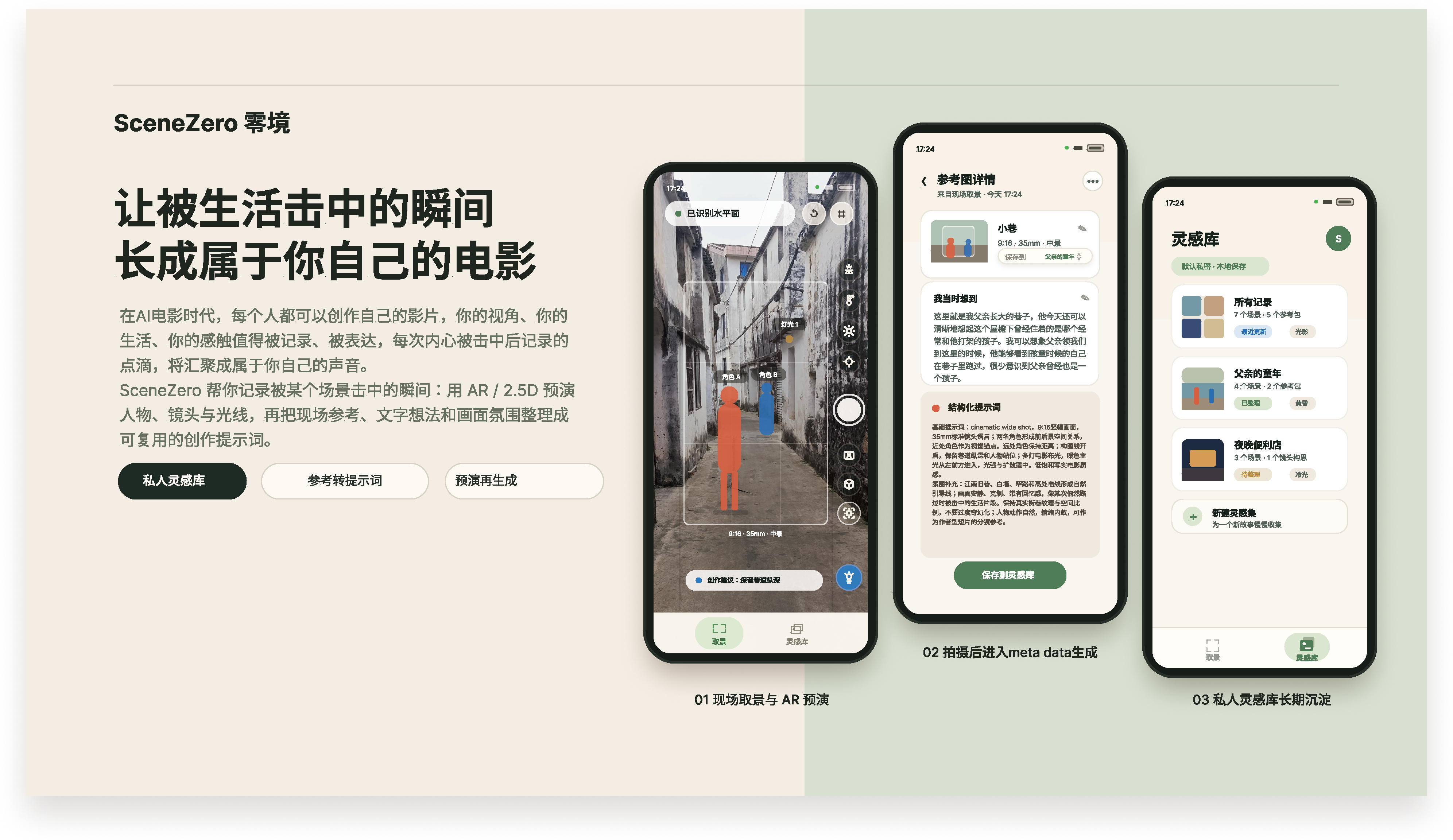
01 · Product problem
AI filmmaking tools often begin after the important observation
Many tools begin with a prompt or generation request. SceneZero starts earlier: when a creator notices a composition, a sound, a spatial relationship, or an emotion that is not yet a complete project.
The design challenge is to keep that first capture lightweight, preserve why it mattered, and introduce camera, spatial, and prompt structure only when the creator chooses to develop it.
02 · Product decisions
Keep capture light; make professional structure progressive
- Inspiration first. A photo, video, note, sound, or music reference is valid without completing a project form.
- AR as an option, not a gate. Spatial staging should help when position and camera language matter, but ordinary capture must remain complete.
- Progressive structure. Camera, lighting, and scene fields appear when useful instead of becoming mandatory metadata.
- Creator control. Observed scene facts, creator intent, and system suggestions remain distinguishable.
- Local-first resilience. Capture, storage, prompt compilation, and current guidance do not depend on a remote model.
03 · Current implementation
The prototype now connects capture, interpretation, and recall
The SceneZeroV2 target implements the core loop with SwiftUI, ARKit, RealityKit, SwiftData, PhotosUI, AVFoundation, and local files. The build contains no remote model endpoint; prompt and suggestion features are deterministic device-side logic.
- 01Capture
Record text, photos, video, audio, and music references, or begin from the live camera.
- 02Stage
Place and manipulate people, props, and light markers while setting frame, lens, shot, and look.
- 03Interpret
Freeze scene facts, resolve spatial relations, compile a structured prompt, and surface rule-based guidance.
- 04Revisit
Search, filter, favorite, group, and recover locally stored inspiration in a private library.
04 · Verification
Evidence that the current target is runnable—not just designed
I re-audited the active SceneZeroV2 target in September 2026 and separated build evidence from features that still require device validation.
- Device build: the unsigned generic iOS build completed in Xcode 26.6 with no Swift compiler warnings.
- Static analysis: the Xcode analyzer completed without warnings.
- Testability: the test bundle compiled and the unit-test suite passed on an iPhone 17 simulator running iOS 26.5.
- Persistence smoke test: a UI test saved a text inspiration, relaunched the app, and retrieved it successfully.
- Launch check: the app installed and opened to the capture interface in the simulator; camera and AR behavior remain real-device work.
05 · Iteration
From a course AR demo to an independent creative system
AR scene previsualization
Established camera framing, spatial placement, reference capture, and a Lookbook workflow.
Inspiration before production
Expanded the entry point from AR scenes to lightweight multimodal fragments for individual creators.
Local-first creative development
Added structured snapshots, offline prompt compilation, explainable rule guidance, multimodal storage, and recovery paths.
06 · Ownership boundary
Product reasoning is the strongest contribution
I defined the product positioning, target creator, interaction principles, information hierarchy, and iteration priorities. The implementation was developed substantially through AI-assisted coding, so I do not present generated code volume as evidence of original algorithmic work.
The defensible contribution is the connection between a product hypothesis and a working iOS artifact: deciding what the tool should help creators preserve, which capabilities should remain optional, and where implementation claims must stop.
07 · Outcome & limits
A verified implementation base, with field evidence still missing
- AR placement, camera capture, lighting previews, and direct manipulation still need structured testing on supported iPhones and iPads.
- No user study has tested whether creators understand, revisit, or benefit from the proposed workflow.
- The prompt compiler and creative advisor are deterministic local rules, not generative AI or evidence of model intelligence.
- The product-direction mockup above communicates the intended experience; visual parity with the current build is not claimed.